

Conversation
Video | July 9, 2026
As co-founder of La Ferme de l’Envol and FermCoop, Paul Charlent has built a collective agricultural model in Essonne that aims to address the major contradictions of modern agriculture: how to feed local communities while regenerating the soil, how to create economic value without offshoring it, and how to produce on a large scale without relying on external inputs. He explains the structure of this model, its deep roots in the local community, and what food sovereignty means in everyday life.
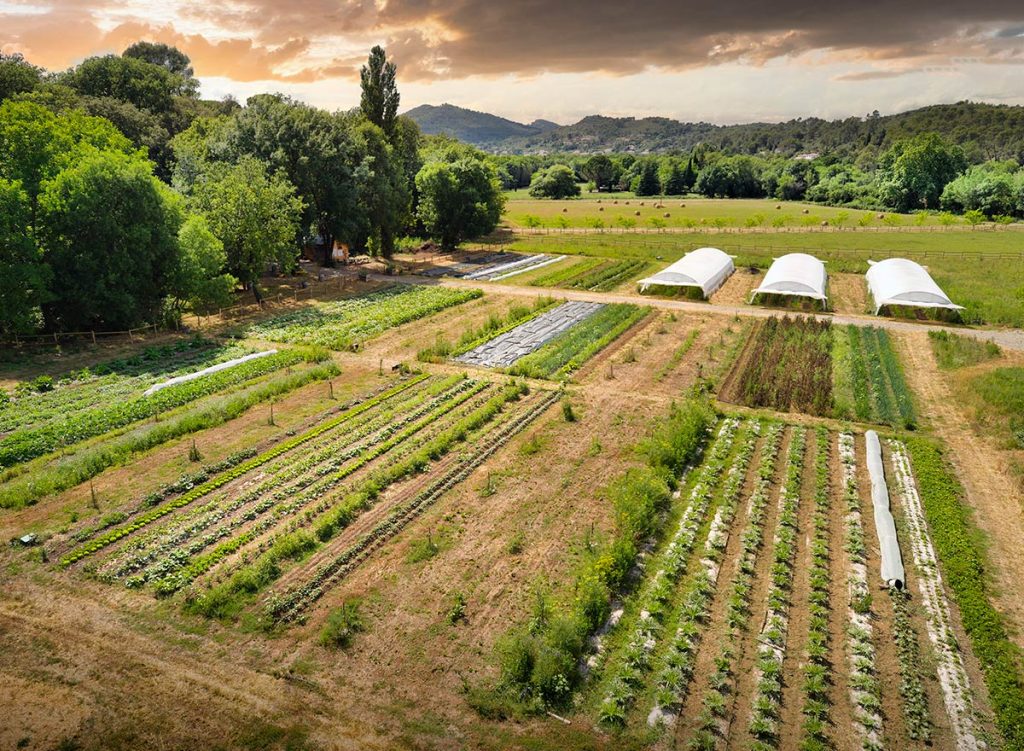
La Ferme de l’Envol is a collective farm in Essonne, dedicated to diversified vegetable farming across 80 hectares, run by a collective of farmers. The starting point for this project was an observation: French agriculture faces structural challenges that go beyond what a single farmer can resolve—the transfer of farms, economic pressure on prices, and agronomic and environmental imperatives. Our response was to build a collective model, where skills, resources, and risks are shared.
This model is based on a mixed farming approach in which each component supports the others. Vegetables feed the residents—we produce more than 200 metric tons per year. Livestock farming transforms organic matter into natural fertilizers that nourish and regenerate the soil. Row crops provide feed for the animals but will soon also produce flour and bread thanks to a farmer-baker who is joining the farm. These operations do not function in parallel but as a system, with each one reinforcing the coherence and resilience of the whole.
The local area is everything, because everything comes from it. This soil, this terroir, this specific land, it is the foundation of what we do. We cannot separate the quality of what we produce from the characteristics of the environment in which we produce it. That is why we treat it not as a resource to be exploited, but as a common good to be cherished and passed on in better condition than we received it.
Our connection to the local area is also evident in our distribution channels. We work directly with local restaurants, community-supported agriculture schemes (AMAPs), and short supply chains, as directly as possible, so that the economic value generated stays in the local area rather than being diluted through long chains of intermediaries. This network of local partners is not just a business strategy. It is the foundation of a model that makes sense: feeding people in our community with what the local land produces, while maintaining a living connection between those who grow the food and those who eat it.
Food sovereignty is often discussed as a political principle or an ideal goal. At La Ferme de l’Envol, it’s an operational reality. We practice agroecology, which means we use no inputs from outside the farm, no synthetic fertilizers, no chemical pesticides, and no products whose manufacture relies on fossil fuels. Our system is self-sustaining: animal manure fertilizes the soil, cover crops protect it, and crop rotation maintains its biological balance.
What we aim to demonstrate is that it’s possible to produce high-quality food by working with the natural resources available on-site: rainwater, solar energy, and soil fertility. Not in spite of constraints, but thanks to them. That’s what real food sovereignty is all about: not depending on globalized and fragile supply chains for production. Restoring our relationship with ecosystems, understanding how they work, and letting them work with us rather than bypassing them.
I’ve known Chloé Charles for a long time. She’s a chef who has always placed ingredients and the people who produce them at the center of her work, not as a marketing ploy, but as a deep-seated conviction. When we were asked to supply the vegetables for this event so she could cook with them, the answer was obvious. Seeing our produce transformed by someone who respects it, tasted by hundreds of people who may have never set foot in a vegetable garden in Essonne, that’s exactly the connection we’re trying to create. Between the land and the table. Between those who grow and those who eat.
Conversation
Podcast
The agricultural transition relies on collective action, creating win-win models where everyone contributes their part and reaps lasting value.
Écouter le podcast
Conversation